WASHINGTON, D.C., February 6, 2020 – The U.S. Department of Agriculture (USDA) today announced the availability of two programs that protect hemp producers’ crops from natural disasters. A pilot hemp insurance program through Multi-Peril Crop Insurance (MPCI) provides coverage against loss of yield because of insurable causes of loss for hemp grown for fiber, grain or Cannabidiol (CBD) oil and the Noninsured Crop Disaster Assistance Program (NAP) coverage protects against losses associated with lower yields, destroyed crops or prevented planting where no permanent federal crop insurance program is available. Producers may apply now, and the deadline to sign up for both programs is March 16, 2020.

Wednesday, March 4, 2020
USDA Announces Details of Risk Management Programs for Hemp Producers
WASHINGTON, D.C., February 6, 2020 – The U.S. Department of Agriculture (USDA) today announced the availability of two programs that protect hemp producers’ crops from natural disasters. A pilot hemp insurance program through Multi-Peril Crop Insurance (MPCI) provides coverage against loss of yield because of insurable causes of loss for hemp grown for fiber, grain or Cannabidiol (CBD) oil and the Noninsured Crop Disaster Assistance Program (NAP) coverage protects against losses associated with lower yields, destroyed crops or prevented planting where no permanent federal crop insurance program is available. Producers may apply now, and the deadline to sign up for both programs is March 16, 2020.

USDA Announces Updates for Honeybee Producers
|
The U.S. Department of Agriculture’s Farm
Service Agency (FSA) announced updates to the Emergency Assistance for
Livestock, Honeybees and Farm-Raised Fish Program (ELAP). These updates
include changes required by the 2018 Farm Bill as well as discretionary
changes intended to improve the administration of the program and clarify
existing program requirements. ELAP was previously administered based on
FSA’s fiscal year but will now run according to the calendar year. Producers
are still required to submit an application for payment within 30 calendar
days of the end of the program year. This is not a policy change but will
affect the deadline. The signup deadline for calendar year 2020 losses is
January 30, 2021.
Starting in 2020, producers will have 15
days from when the loss is first apparent, instead of 30 days, to file a
honeybee notice of loss. This change provides consistency between ELAP and
the Noninsured Crop Disaster Assistance Program, which also has a 15-day
notice of loss period for honey. For other covered losses, including
livestock feed, grazing and farm-raised fish losses, the notice of loss
deadline for ELAP will remain 30 days from when the loss is first apparent to
the producer.
Program participants who were paid for the
loss of a honeybee colony or hive in either or both of the previous two years
will be required to provide additional documentation to substantiate how
current year inventory was acquired.
If the honeybee colony loss incurred was
because of Colony Collapse Disorder, program participants must provide a
producer certification that the loss was a direct result of at least three of
the five symptoms of Colony Collapse Disorder, which include:
For honeybees, ELAP covers colony losses,
honeybee hive losses (the physical structure) and honeybee feed losses in
instances where the colony, hive or feed has been destroyed by a natural
disaster or, in the case of colony losses, because of Colony Collapse
Disorder. Colony losses must be in excess of normal mortality.
ELAP also provides emergency assistance to
eligible producers of livestock and farm-raised fish including for feed and
grazing losses. It covers losses because of eligible adverse weather or loss
conditions, including blizzards and wildfires on federally managed lands. ELAP
also covers losses resulting from the cost of transporting water to livestock
due to an eligible drought.
For more information on ELAP visit farmers.gov/recover
or contact your FSA County Office. To locate your local FSA office,
visit farmers.gov/service-locator.
Questions?
Please contact your local FSA Office. |
Thursday, February 20, 2020
Converting pastures to novel endophyte tall fescue.
The Alliance for Grassland Renewal, in collaboration with Virginia Tech’s Shenandoah Valley and Middleburg Agricultural Research and Extension Centers and Virginia Cooperative Extension, is hosting a workshop on educating farmers and landowners about converting pastures to novel endophyte tall fescue.
The workshop will cover the pasture conversion process, common misperceptions about these forage technologies, and how to determine whether switching to novel endophyte tall fescue will be a profitable decision for a farm.
The event is open to the public and registration can be found at this link.
Tall fescue dominates Virginia pastures. A fungus living inside this grass, called an endophyte, helps tall fescue persist through droughts and other stressful events.
However, this fungus often produces chemicals that impair the ability of livestock to regulate their body temperatures properly.
Scientists have developed new varieties of tall fescue containing novel endophytes. These novel endophytes help the grass persist, but do not produce chemicals that hurt livestock.
Utilizing these varieties of tall fescue can improve cow conception rates and increase calf weaning weights by around 50 pounds per calf.
Despite the benefits, few farmers have adopted these new technologies. Farmers worry about the cost of renovating pastures and often are unsure of how to manage the conversion process.
Virginia Tech scientists also conduct research across Virginia to determine the most effective ways to establish and utilize these novel tall fescue varieties. Extension agents and specialists host pasture walks, provide site-specific expertise to farmers, and publish informational articles on tall fescue.
Tuesday, February 18, 2020
Good
afternoon,
If
you have not already visited your local Farm Service Agency (FSA) county office
to make your election for either the Agriculture Risk Coverage (ARC) or the Price Loss Coverage (PLC)
program and to sign your annual enrollment contract, you should call and make
your appointment now. March 16, 2020 is the enrollment deadline for the 2019
crop year.
ARC and PLC provide
financial protections to farmers from substantial drops in crop prices or
revenues and are vital economic safety nets for most American farms. These
programs cover 20 commodities produced in the U.S.
If you fail to enroll by the deadline, you are ineligible
to receive payment for 2019 ARC/PLC.

Friday, February 7, 2020
Hay producers I need your help!

A multi-state hay production survey is being conducted in a quality improvement study designed to better understand producer management practices in the Southeast. Producers 18 years or older are eligible. The survey should not take more than about 10 min to complete and will provide important information for extension programming. This information may be shared with other institutions upon request.
Monday, January 13, 2020
Stress and Anxiety "Things on the Farm Are Not As Ideological as they Appear"
Farming has always been one of the most demanding career paths that a person could choose to navigate. On top of that there are natural disasters followed by more natural disasters, commodity and financial stresses combined with sometimes uncertain trade situations. Today's farmers are declaring bankruptcy at higher rates, having to choose to sell their land to make ends meet or facing skyrocketing input cost. Farming is so stressful that the agricultural industry has higher rates of suicide than most other occupations.

Farmers are sometimes unable to "weather the storm" or wait for things to "bounce back", they don't see a "niche" market or new commodity that they could afford to implement. They are having to sell out, but finding that the sales profits aren't enough to cover there debts or secure their futures. That makes many farmers wonder why previous generations could run the farm and be profitable but they can not. Some feel they are letting past as well as current generations down, all the while never understanding that circumstances are more challenging than ever before.
Farmers must love the soil, plants and or animals they care for daily and acquire the training and knowledge to do so. They also must have a combination of effective mechanical, administrative, marketing, logistics, communication, decision making skills, time management, and interpersonal skills to be effective. Plus, they have to be risk takers as every time a seed is planted or a cow is bred they hoping that the future will smile upon them.
All of this can lead to depression, anxiety and a ongoing lack of sleep. Farmers are generally a proud breed of people and sometime are to strong willed to ask for help. Internalization of problems or concerns and lack of knowing who to talk too that won't condemn or whom they feel won't pass judgement is sometimes a barrier to help.


Are you struggling with any of the following? You may want assistance.
- If you don't have a strong support network.
- If you don't have someone to talk with, lean on or trust.
- Your thoughts and emotions interfere with your daily life or activities.
- Your sadness or feelings of melancholy impact your work, school or relationships.
- You exhibit or are afraid you might be prone to unimaginable impulsiveness, anger or violence.
- You find yourself isolating your self from others.
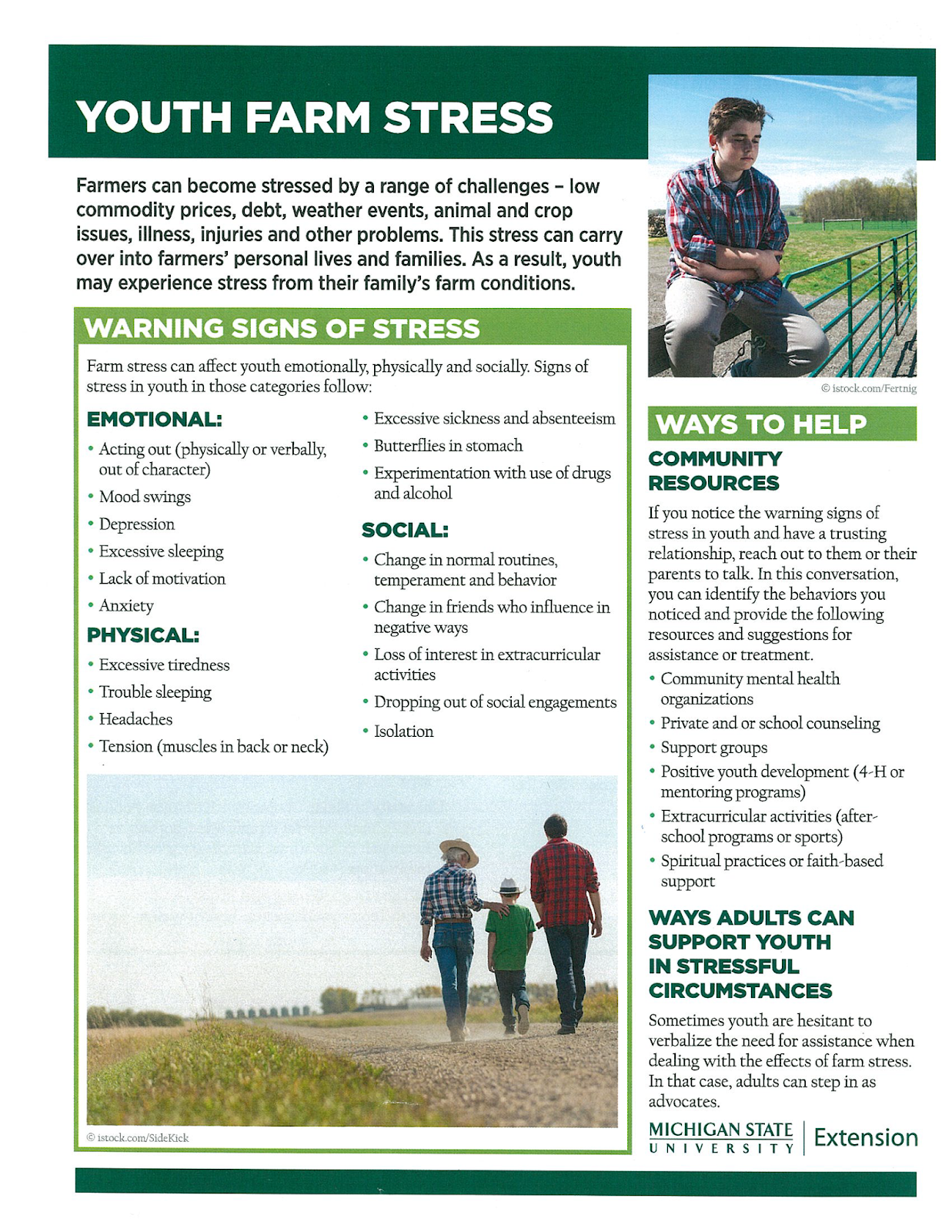
 If you are one of farmers or land owners who are looking for assistance, need sometime to "hear you", please review some of the ways stress and anxiety can affect your body, your thoughts and affect you. Create a Coping Strategies Plan, or find someone to talk with about your concerns.
Wednesday, January 8, 2020
Subscribe to:
Posts (Atom)